
内存管理 - 内存布局、Tagged Pointer、MRC、Copy
在本章中,我们将学习内存布局、Tagged Pointer技术、MRC、Copy、引用计数和week的实现原理。先来了解一下程序在内存中的布局。
内存布局
APP内的代码、字符串、常量、对象它们在内存中的排序是怎么样?通过下面这张图来了解一下: 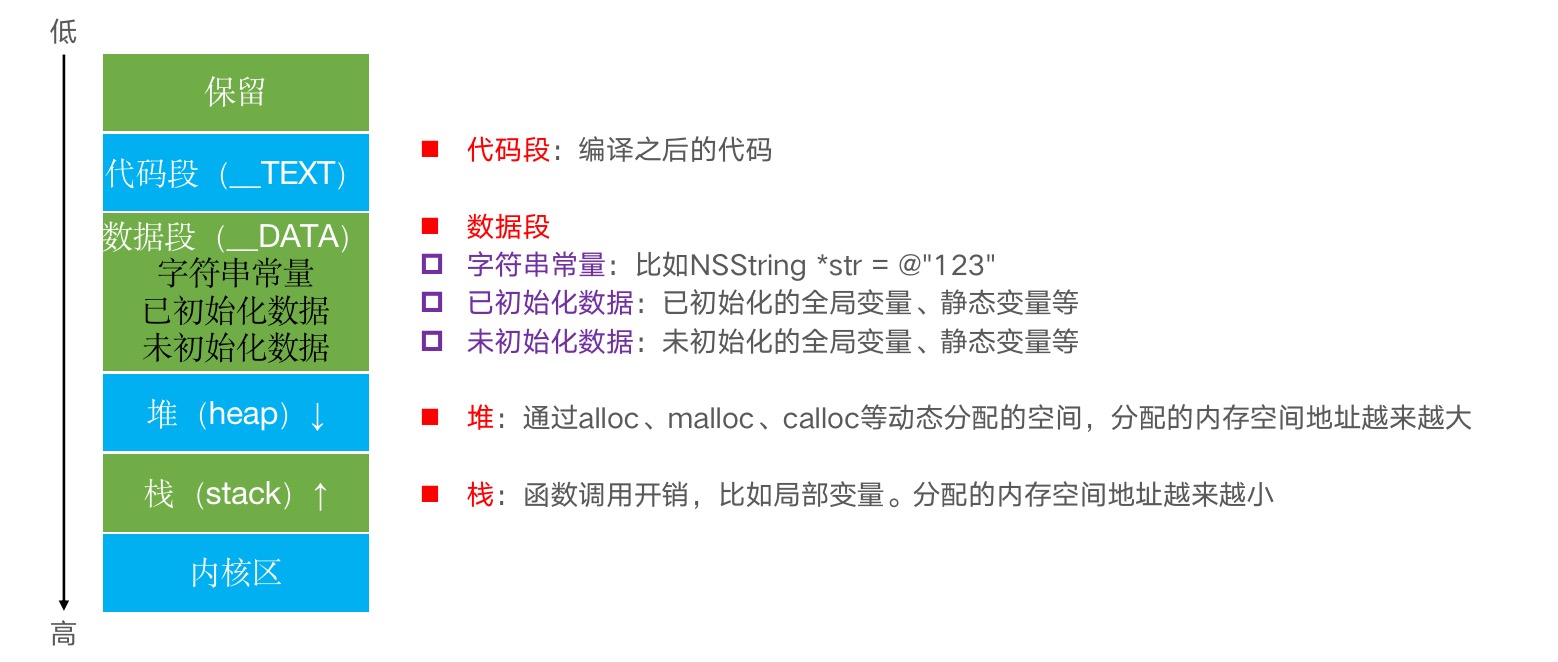 通过上图我们了解到,内存中的排序是
代码段内存地址 < 数据段内存地址 < 堆地址 < 栈地址 < 内核区地址,注意:堆、栈可能会有部分地址混用,根据上图显示,堆地址是从低地址往高地址分配,而栈地址是高地址往低地址分配,这样有可能造成部分内存混用。
通过打印全局变量、静态变量、局部变量、对象 指针地址的方式进行验证:
int a = 10;
int b;
- (void)viewDidLoad {
    [super viewDidLoad];
    static int c = 20;
    static int d;
    int e = 30;
    int f;
    NSString *str = @"234567543213456";
    NSObject *obj = [[NSObject alloc] init];
    NSObject *obj1 = [[NSObject alloc] init];

    NSLog(@"\n a = %p \n b = %p \n c = %p \n d = %p \n e = %p \n f  = %p \n str = %p \n obj = %p \n obj1 = %p \n",&a,&b,&c,&d,&e,&f,str,obj,obj1);
}

打印结果:
// 字符串常量
str = 0x10f289040

// 已初始化全局变量、静态变量
a = 0x10f28e580
c = 0x10f28e584

// 未初始化的全局变量、静态变量
b = 0x10f28e64c
d = 0x10f28e648

// 堆
obj = 0x600001544080
obj1= 0x600001544090

// 栈
f =   0x7ffee0978d00
e = 0x7ffee0978d04通过打印结果我们看到:字符串的内存地址最低,栈的内存地址最高,并且栈内存地址是从高地址往低地址分配。也验证了我们上面的说法是正确的。
Tagged Pointer
从64bit开始,iOS引入了Tagged Pointer技术,主要用于优化 NSNumber、NSDate、NSString等小对象的存储。
在没有使用Tagged Pointer之前, NSNumber 等对象需要动态分配内存、维护引用计数等,NSNumber 指针存储的是堆中 NSNumber 对象的地址值。
使用Tagged Pointer之后,NSNumber指针里面存储的数据变成了:Tag + Data,也就是将数据直接存储在了指针中,当指针不够存储数据时,才会使用动态分配内存的方式来存储数据。
在调用方法时,objc_msgSend 能识别 Tagged Pointer,比如 NSNumber 的 intValue 方法,直接从指针提取数据,节省了以前的调用开销
通过打印地址验证
在现在的版本中,为了保证数据安全,苹果对 Tagged Pointer 做了数据混淆,开发者通过打印指针无法判断它是否是一个Tagged Pointer对象,更无法读取它的存储数据。在分析Tagged Pointer之前,可以通过添加环境变量OBJC_DISABLE_TAG_OBFUSCATION为 YES 关闭混淆。通过打印存储的地址进行判断:
int main(int argc, const char * argv[]) {
    @autoreleasepool {
        NSNumber *num1 = @4;
        NSNumber *num2 = @5;
        NSNumber *num3 = @6;
        NSString *str = [NSString stringWithFormat:@"abc"];
        NSLog(@"%p %p %p %p %p",num1,num2,num3,str);
        NSLog(@"%@",[str class]);
    }
    return 0;
}
// 关闭加密混淆: 0x427 0x527 0x627 0x63626135
// 开启加密混淆: 0xd19eac0b6d90790b 0xd19eac0b6d90780b 0xd19eac0b6d907b0b 0xd19eac0b0ef21c19
// str的类型: NSTaggedPointerString根据打印地址我们看到,关闭加密混淆之后打印的地址值包含着NSNumber对象的值,字符串也是,61在ACSII码中代表a,62代表b,63代表c。
如何判断一个指针是否为Tagged Pointer?
判断一个对象是不是属于Tagged Pointer,在Mac平台,最低有效位是1,在iOS平台,最高有效位是1(第64bit),我们也可以通过runtime源码确认我们的说法是否正确:
static inline bool
_objc_isTaggedPointerOrNil(const void * _Nullable ptr)
{
    return !ptr || ((uintptr_t)ptr & _OBJC_TAG_MASK) == _OBJC_TAG_MASK;
}

#if __arm64__
#   define OBJC_SPLIT_TAGGED_POINTERS 1
#else
#   define OBJC_SPLIT_TAGGED_POINTERS 0
#endif

#if (TARGET_OS_OSX || TARGET_OS_MACCATALYST) && __x86_64__
    // 64-bit Mac - tag bit is LSB
#   define OBJC_MSB_TAGGED_POINTERS 0
#else
    // Everything else - tag bit is MSB
#   define OBJC_MSB_TAGGED_POINTERS 1
#endif

#if OBJC_SPLIT_TAGGED_POINTERS
#   define _OBJC_TAG_MASK (1UL<<63)
#elif OBJC_MSB_TAGGED_POINTERS
#   define _OBJC_TAG_MASK (1UL<<63)
#else
#   define _OBJC_TAG_MASK 1UL
#endif
Tagged Pointer的面试题,判断下面这两段代码会有什么结果
// 代码1
dispatch_queue_t queue = dispatch_queue_create("queue", DISPATCH_QUEUE_CONCURRENT);
for (int i = 0; i < 1000; i++) {
    dispatch_async(queue, ^{
        self.name = [NSString stringWithFormat:@"abcdefghijklmn"];
    });
}

// 代码2
dispatch_queue_t queue = dispatch_queue_create("queue", DISPATCH_QUEUE_CONCURRENT);
for (int i = 0; i < 1000; i++) {
    dispatch_async(queue, ^{
        self.name = [NSString stringWithFormat:@"abc"];
    });
}运行上面两段代码,我们发现在运行代码1的时候发生了坏内存访问,崩溃在objc_release()方法,这是因为虽然项目是ARC环境,但是ARC的本质还是MRC,系统默认帮我们实现了之前需要自己写的 return 和 release 操作。当我们给 name 属性赋值时,调用的方法是setName:函数。在函数内部,系统帮我们实现了release操作。代码如下:
- (void)setName:(NSString *)name{
    if (_name != name) {
        [_name release];
        _name = [name copy];
    }
}当我们使用多个线程同时调用此方法时,就会产生坏内存访问。解决方案也很简单,在调用setName:函数之前进行加锁就可以了。
为什么代码2没有产生崩溃,这是因为代码2的字符串使用了Tagged Pointer,字符串本身就是存储在指针中,不需要调用release方法。
MRC
在iOS中,使用引用计数来管理OC对象的内存,一个新创建的OC对象引用计数默认是1,当引用计数减为0,OC对象就会销毁,释放其占用的内存空间。调用retain会让OC对象的引用计数+1,调用release会让OC对象的引用计数-1。
MRC环境下,需要程序员自己调用return和release操作。当使用其他对象作为成员变量时,需要在set方法中进行return,在dealloc方法中进行release。举个🌰:
@interface Person : NSObject
@property (nonatomic, strong)Cat *cat;
@end

@implementation Person

- (void)setCat:(Cat *)cat{
    if (_cat != cat) {
        [_cat release];
        _cat = [cat retain];
    }
}

- (void)dealloc{
    [_cat release];
    _cat = nil;
    [super dealloc];
}
@endCopy
如果要了解Copy,我们就得知道Copy的目的是什么?我们想要的是Copy后的文件内容和要拷贝的文件内容一致。并且修改其中一个文件内容不会改变另一个文件内容。
知道了Copy的目的,我们再来了解什么是深拷贝、什么是浅拷贝。深拷贝和浅拷贝的区别在于:调用copy方法时,需不需要重新开辟一块内存空间,如果需要开启新的内存空间,就属于深拷贝,如果不需要,属于浅拷贝。深拷贝属于内容拷贝,会产生新的对象。浅拷贝属于指针拷贝,没有产生新的对象。
iOS中提供了两个拷贝方法,copy和mutableCopy。copy: 不可变拷贝,产生一个不可变的副本。mutableCopy: 可变拷贝,产生可变副本。
不同类型下的深拷贝和浅拷贝
| 类型 | copy | mutableCopy |
|---|---|---|
| NSString | NSString 浅拷贝 | NSMutableString 深拷贝 |
| NSMutableString | NSString 深拷贝 | NSMutableString 深拷贝 |
| NSArray | NSArray 浅拷贝 | NSMutableArray 深拷贝 |
| NSMutableArray | NSArray 深拷贝 | NSMutableArray 深拷贝 |
| NSDictionary | NSDictionary 浅拷贝 | NSMutableDictionary 深拷贝 |
| NSMutableDictionary | NSDictionar 深拷贝 | NSMutableDictionary 深拷贝 |
成员变量使用copy进行修饰时的注意事项:
当我们使用copy修饰成员变量时,代表调用当前属性的copy方法。根据之前所讲,即使我们是可变对象,调用copy方法之后,返回的也是一个不可变对象。举个🌰:
@interface Person : NSObject
@property (nonatomic,copy)NSMutableArray *ary;
@end

- (void)viewDidLoad {
    [super viewDidLoad];

    Person *person = [[Person alloc] init];
    person.ary = [NSMutableArray array];

    NSMutableArray *dataAry = person.ary;
    [dataAry addObject:@"123456"];
}当往dataAry中添加成员时,会造成程序崩溃-[__NSArray0 addObject:]: unrecognized selector sent to instance,这就有点奇怪了,我们的数组不是一个可变数组吗?为什么会报这个错误?
主要原因在于: 我们是使用copy对成员变量进行修饰。当我们对数组进行初始化时,调用的是setAry:函数,在函数内部,系统会调用[ary copy]方法返回一个新的不可变数组,所以在往数组中添加数据时会报找不到方法的错误。相当于以下代码:
- (void)setAry:(NSMutableArray *)ary{
    if (_ary != ary) {
        [_ary release];
        _ary = [ary copy];
    }
}为什么系统使用copy修饰可变的字符串:
我们在使用UITextField时,看到attributedText属性就是使用copy进行修饰的,为什么系统要使用copy修饰可变的字符串呢?
这牵扯到设计思想的问题。iOS并不希望你在赋值之后,在使用过程中更改字符串,文本框的内容也要跟着改变。他更多的是希望你将字符串初始化好之后对其进行赋值。赋值之后对字符串的操作也影响不到UITextField控件内部字符串内容。
引用计数
在iOS中,使用引用计数来管理OC对象的内存,一个新创建的OC对象引用计数默认是1,当引用计数减为0,OC对象就会销毁,释放其占用的内存空间,调用retain会让OC对象的引用计数+1,调用release会让OC对象的引用计数-1。
当调用alloc、new、copy、mutableCopy方法返回了一个对象,在不需要这个对象时,要调用release或者autorelease来释放它。想拥有某个对象,就让它的引用计数+1;不想再拥有某个对象,就让它的引用计数-1
可以通过私有函数extern void _objc_autoreleasePoolPrint(void);来查看自动释放池的情况
引用计数存储的位置
在64bit中,引用计数可以直接存储在优化过的isa指针中(extra_rc)。当引用计数过大无法存储在isa中时,has_sidetable_rc值会设为1,引用计数会被存储在SideTable类的属性中
struct SideTable {
    spinlock_t slock;
    RefcountMap refcnts;  // 存放着对象引用计数的散列表
    weak_table_t weak_table; // 存放着weak对象的散列表
};weak
我们都知道__weak是弱引用,它内部是怎么实现的呢?我们先通过一段代码来展示使用不同修饰词引用对象时,对象的释放时机会发生变化:
- (void)viewDidLoad {
    [super viewDidLoad];
    __strong Person *person1;
    __weak Person *person2;
    __unsafe_unretained Person *person3;

    NSLog(@"begin");
    {
        Person *person = [[Person alloc] init];
        person1 = person;
        // person2 = person;
        // person3 = person;
    }
    NSLog(@"end ");
}在上面的代码中,当我们通过__strong引用 person 时,打印 end 之后才会释放Person对象,而通过__weak和__unsafe_unretained引用 person 时,在打印 end 之前就会释放Person对象。
__weak和__unsafe_unretained的区别
__weak: 在释放Person对象时会将实例对象设置为nil__unsafe_unretained: 在释放Person对象时不会更改实例对象的值
__weak为什么可以将实例对象设置为nil
通过runtime源码进行解读: dealloc->_objc_rootDealloc()->rootDealloc()->object_dispose()->objc_destructInstance()-> obj->clearDeallocating()
objc_object::rootDealloc()
{
    if (isTaggedPointer()) return;  // fixme necessary?

    // 如果是一个优化过的isa指针 && 没有弱引用 && 没有关联对象 && 没有c++构造函数 && 没有使用sidetable存储引用计数
    if (fastpath(isa.nonpointer                     &&
                 !isa.weakly_referenced             &&
                 !isa.has_assoc                     &&
                 !isa.getClass(false)->hasCxxDtor() &&
                 !isa.has_sidetable_rc))
    {
        free(this);
    }
    else {
        object_dispose((id)this);
    }
}

inline void
objc_object::clearDeallocating()
{
    if (slowpath(!isa.nonpointer)) {
        // Slow path for raw pointer isa.
        sidetable_clearDeallocating();
    }
    else if (slowpath(isa.weakly_referenced  ||  isa.has_sidetable_rc)) {
        // Slow path for non-pointer isa with weak refs and/or side table data.
        clearDeallocating_slow();
    }
}

/***********************************************************************
* objc_destructInstance
* Destroys an instance without freeing memory.
* Calls C++ destructors.
* Calls ARC ivar cleanup.
* Removes associative references.
* Returns `obj`. Does nothing if `obj` is nil.
**********************************************************************/
void *objc_destructInstance(id obj)
{
    if (obj) {
        // Read all of the flags at once for performance.
        bool cxx = obj->hasCxxDtor();
        bool assoc = obj->hasAssociatedObjects();

        // This order is important.
        if (cxx) object_cxxDestruct(obj);  //清除成员变量
        if (assoc) _object_remove_assocations(obj, /*deallocating*/true); // 移除关联对象
        obj->clearDeallocating();  // 将指向当前对象的弱指针置为nil
    }
    return obj;
}

inline void
objc_object::clearDeallocating()
{
    if (slowpath(!isa.nonpointer)) {
        // Slow path for raw pointer isa.
        sidetable_clearDeallocating();
    }
    else if (slowpath(isa.weakly_referenced  ||  isa.has_sidetable_rc)) {
        // Slow path for non-pointer isa with weak refs and/or side table data.
        clearDeallocating_slow();
    }
}

NEVER_INLINE void
objc_object::clearDeallocating_slow()
{
    SideTable& table = SideTables()[this];
    table.lock();
    if (isa.weakly_referenced) {
        weak_clear_no_lock(&table.weak_table, (id)this);
    }
    if (isa.has_sidetable_rc) {
        table.refcnts.erase(this);
    }
    table.unlock();
}

// 由dealloc调用; 清除所有指向所提供对象的弱指针,以便不再使用它们
void
weak_clear_no_lock(weak_table_t *weak_table, id referent_id)
{
    objc_object *referent = (objc_object *)referent_id;

    weak_entry_t *entry = weak_entry_for_referent(weak_table, referent);
    if (entry == nil) {
        return;
    }

    // zero out references
    weak_referrer_t *referrers;
    size_t count;

    if (entry->out_of_line()) {
        referrers = entry->referrers;
        count = TABLE_SIZE(entry);
    }
    else {
        referrers = entry->inline_referrers;
        count = WEAK_INLINE_COUNT;
    }

    for (size_t i = 0; i < count; ++i) {
        objc_object **referrer = referrers[i];
        if (referrer) {
            if (*referrer == referent) {
                *referrer = nil;
            }
            else if (*referrer) {
                objc_weak_error();
            }
        }
    }
    weak_entry_remove(weak_table, entry);
}在源码中我们看到,在clearDeallocating_slow方法中,会获取到当前对象的引用计数类SideTable,将弱引用表传入weak_clear_no_lock()中。又通过weak_entry_for_referent函数获取到弱引用表,对其进行置 nil 操作。